

The strongest evidence a building can offer about its performance is not a good number. It is the same number twice.
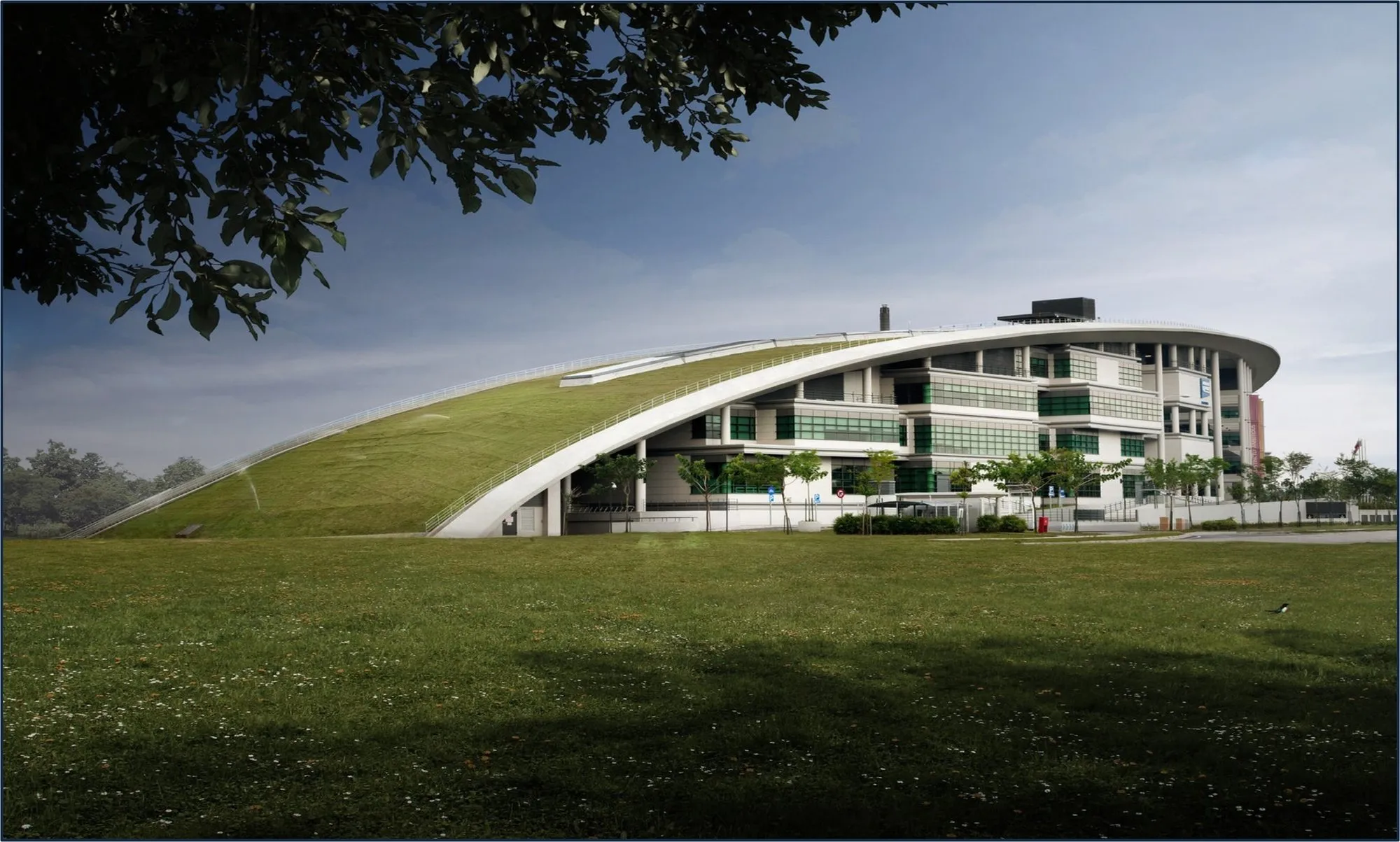
The Heriot-Watt University Malaysia campus in Precinct 5, Putrajaya, comprises approximately 24,601 m2 of educational facilities and is owned by Putrajaya Holdings. It is assessed under the GBI Non-Residential New Construction tool rather than GreenRE, with the renewal certificate issued on 18 December 2020 at 59 of 100 points.
The figure that matters
Advanced energy efficiency performance achieved 10 of 15, with a building energy intensity of 103 kWh/m2/year confirmed at both the initial and the renewal assessment.
A single measurement can be a good year, a quiet semester, a meter read at a convenient moment. The same figure recorded years apart, through a change of occupancy and a change of operating staff, is something else. It says the number is structural.
Verified OTTV was 46 W/m2 and the heavyweight roof U-value 0.54 W/m2K. The building automation system is documented across 3,586 input and output points, which is the quiet reason the figure holds: a building that is instrumented at that density is a building somebody can actually manage.
Commissioning scored accordingly. Enhanced commissioning 3 of 3, post-occupancy commissioning 2 of 2, energy efficiency verification 2 of 2, and sustainable maintenance 3 of 3. All full marks, and all concerned with proving and preserving performance rather than designing it.
One honest note
The campus is widely described as daylit, and in use it is. The GBI daylighting credit scored zero of two.
That is not a contradiction and it is worth understanding. Daylight that is pleasant to occupy and daylight that satisfies a credit’s measurement protocol are different things. The credit has a defined calculation method, and a design that was never tested against that method will not satisfy it however bright the rooms are.
We publish that result rather than omitting it, because the distinction is the single most common cause of a client being surprised late in an assessment.
By category
Energy efficiency 24 of 35, indoor environmental quality 12 of 21, sustainable site planning and management 12 of 16, materials and resources 6 of 11, water efficiency 2 of 10, innovation 3 of 7.
Water is the clear gap. Fittings took full marks, but rainwater harvesting, water recycling, efficient irrigation and metering all scored zero, and together they are eight available points.
For institutional estates
A campus is the ideal candidate for this kind of work. Occupancy is predictable, the estate is held for decades, and the operator is the same organisation that pays the bills. The instrumentation and commissioning credits that reward long-term stewardship are exactly the ones an institution is positioned to win.