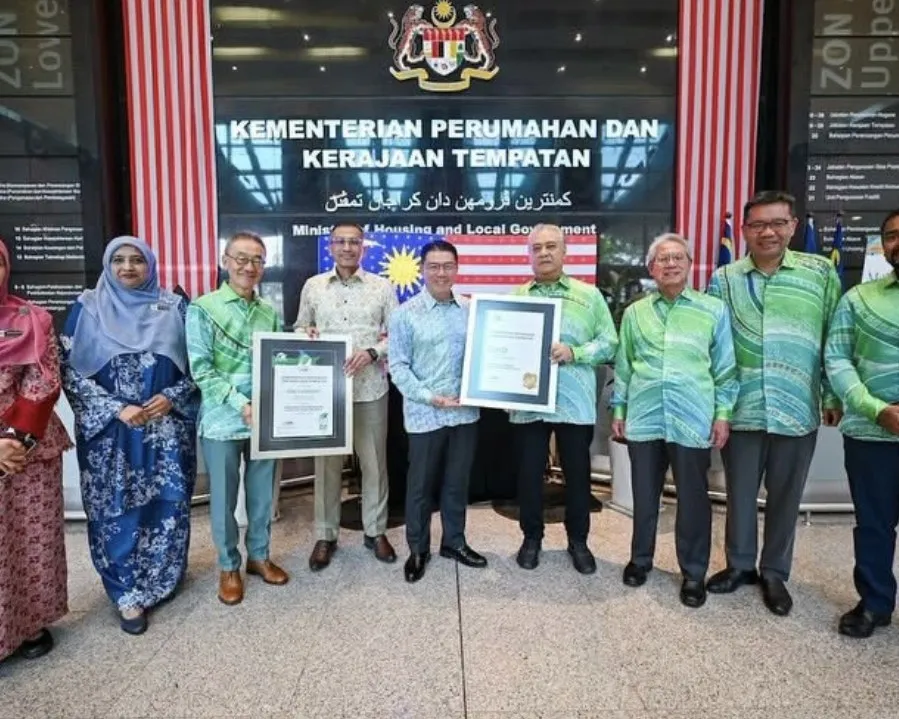



A first certificate says a building was designed and built to a standard. A renewal says it is still being run to one. For a tenant, a lender or an ESG reporting team, the second claim is the more useful of the two, and it is the harder one to make.
1 Powerhouse is a 31-storey mixed-use development in Bandar Utama combining office, hotel and podium accommodation across 159,137 m², developed by Bandar Utama Assets. It already held GreenRE Gold. The renewal was assessed in March 2026 and approved in April at 87.30 of 100 points under NRB v3.0.
The envelope and the plant both held
OTTV took the full 15 of 15. Aerated concrete blocks and low-emissivity glazing reduce the heat the building has to reject before any plant runs, and the credit confirms that performance has not degraded.
Air-conditioning plant took the full 20 of 20, and air distribution a full 5 of 5. The cooling system uses chilled-water thermal energy storage, producing and storing cooling off-peak for use during the day. That is a peak-load strategy as much as an efficiency one, and it only continues to pay if the controls are still being operated as designed. A renewal is where you find out.
Lifts and escalators took 3 of 3, and car park ventilation 4.38 of 5.
Transit, and a point about location credits
The development connects directly to the Bandar Utama MRT station, with elevated pedestrian links, roughly 500 park-and-ride bays, feeder bus areas and covered walkways. Public transport accessibility and the covered walkway credit each took a full point.
Location credits are unusual in that they cannot degrade. Once a building is next to a station it stays next to a station. For an asset expecting to recertify every few years, credits of that kind are the stable floor the rest of the score sits on.
Where the points were not
Artificial lighting took 5 of 12 and common-area ventilation 2 of 5. Environmental management took 4 of 8. Innovations reached 3 of 7, credited across chilled-water storage, ultraviolet disinfection, siphonic drainage, condensate recovery and recycled fire-system water.
For asset owners
If you hold a certificate that is approaching renewal, the work starts well before the assessment. What determines a renewal result is whether the operational records exist, whether the plant is still running at its design intent, and whether anyone has been watching the energy figure in the intervening years.
A renewal is cheap when a building has been run properly and expensive when it has not. That asymmetry is the whole argument for treating certification as an operating discipline rather than a handover document.